Skip to content

Prague · 28 Cheshvan 5787

Shabbat this week · 16:02–17:11

Ashkenazi

Challah

חַלָּהbarchesAwaiting expert review

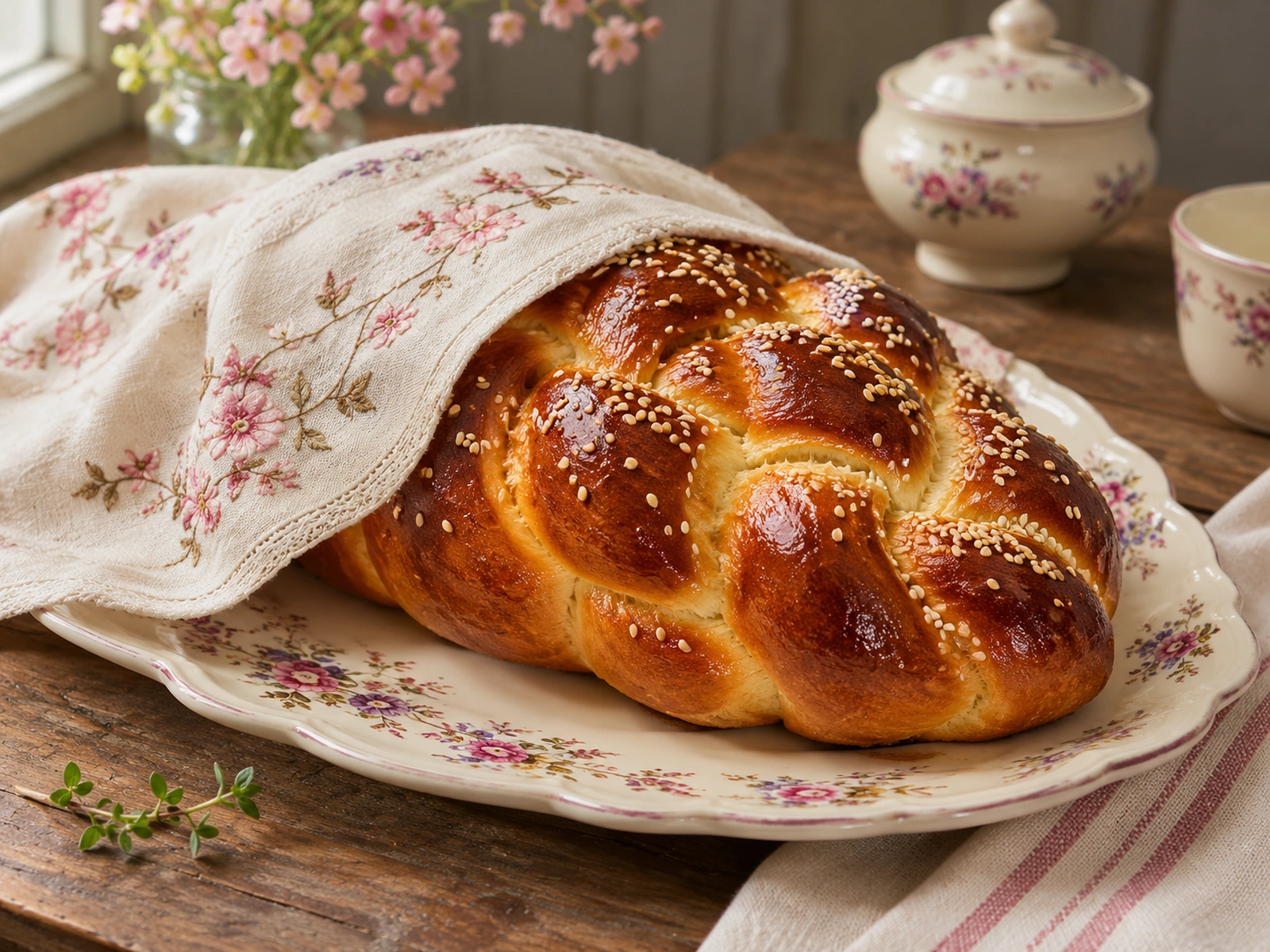
Braided festive bread for Shabbat and holidays. A soft yeast dough with eggs and oil; parve, with no milk or butter.

Servings
12 servings
Prep
40 min
Cook
35 min
Difficulty
moderate
Kashrut · pareveCategory by ingredients, not a certification. Details below.
Challah

Ingredients

12
servings

Dough

Topping

Method

  1. Step 1: Dissolve the yeast in 100 ml of lukewarm water with a teaspoon of sugar and leave for 10 minutes to activate.

  2. Step 2: Sift the flour into a bowl and add the remaining sugar and the salt. Pour in the yeast mixture, the rest of the water, the oil and 3 beaten eggs.

  3. Step 3: Knead for 10–12 minutes into a smooth, elastic dough that does not stick to your hands. If it is too stiff, add a tablespoon of water; if it is sticky, add a little flour.

  4. Step 4: Cover the bowl and let the dough rise in a warm place for 60–90 minutes, until doubled in volume.

  5. Step 5: If you are separating challah, do it now, before dividing the dough.

  6. Step 6: Divide the dough into two halves and each half into 3–6 equal pieces. Roll them into strands about 35 cm long and braid two loaves.

  7. Step 7: Transfer the loaves to a baking sheet lined with parchment paper, cover and let them proof for another 30–40 minutes.

  8. Step 8: Preheat the oven to 180 °C. Brush the loaves with beaten egg, let it dry for 5 minutes and brush a second time; sprinkle with sesame or poppy seeds.

  9. Step 9: Bake for 30–35 minutes until golden. A finished challah sounds hollow when tapped on the bottom.

  10. Step 10: Let it cool on a wire rack; on Shabbat it is served covered with a cloth.

Tips

  • Brushing with egg twice gives a glossy, deep golden crust.
  • The dough can rise overnight in the fridge; let it come to room temperature for an hour before braiding.

History and origins

Bible

In the Torah the word challah חַלָּה denotes a portion of the dough that was given to the priest. This commandment (hafrashat challah) is still observed symbolically today by separating a small piece of dough; only later was the word transferred to the festive bread itself.1

Minhag

Two loaves (lechem mishneh) are placed on the Shabbat table as a reminder of the double portion of manna that the Israelites gathered on Friday.2

HistoryAshkenazim⁂ To verify

The braided form made from a rich egg dough is typical of the Ashkenazi communities of Central and Eastern Europe; in German and some Central European areas the Shabbat bread was also called barches (berches).3

Regional variations

MinhagAshkenazim⁂ To verify

For Rosh Hashanah challah is traditionally baked round (often in a spiral), sometimes with raisins and honey; the circle is often interpreted as a symbol of the cycle of the year.

MinhagSephardimMizrahim⁂ To verify

Sephardi and Middle Eastern communities have their own festive breads, often unbraided and flavored with anise or sesame; the braided egg challah is primarily an Ashkenazi tradition.
Goes well with

Sources

Primary sources

  1. 1Numbers, 15:17–21 text ↗
  2. 2Exodus, 16:22–26 text ↗