Origin
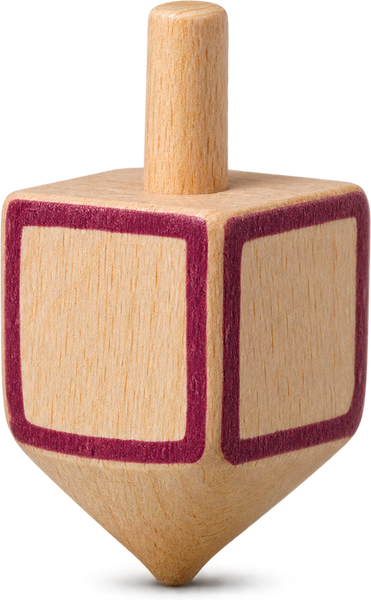
The game with a four-sided top was known in Europe (German Trendel, English teetotum), and Jews probably adopted it in the early modern period; the letters on its sides replaced the Latin letters of the game.1
The story that Jews under Antiochus pretended to play with a top in order to hide forbidden Torah study is a folk legend without ancient sources.
Meaning
The letters נ ג ה ש (nun, gimel, he, shin) are interpreted as an abbreviation of nes gadol hayah sham – "a great miracle happened there". In Israel the top has the letter פ (pe) instead of shin: nes gadol hayah po – "here".
Later interpretations find further meanings in the letters, such as the numerical value 358, the same as that of the word mashiach.
Use
In the Yiddish version of the game the letters mean: nun – nothing (nisht), gimel – take all (gants), he – take half (halb), shin – put in (shtel arayn).
Historical development
The Hebrew word sevivon was coined in Modern Hebrew by Itamar Ben-Avi, son of Eliezer Ben-Yehuda.
Related traditions
It is played after the candles are lit, when by custom no work is done; people play for coins, nuts or chocolate "gelt".
In Israel competitions are held for the longest-spinning sevivon.
FAQ
What do the letters on the dreidel mean?
Nes gadol hayah sham – "a great miracle happened there"; in Israel, "here".
Is the dreidel a religious object?
No, it is a folk game associated with Hanukkah, without halakhic standing.