Mazeltov.cz מסביר, לא פוסק. מנהגי הכשרות משתנים לפי קהילה, זרם ומשפחה. בשאלה מעשית פנו לרב הקהילה שלכם. הטקסטים במדור זה הם טיוטת מערכת שממתינה לבדיקה מקצועית.
Mammals: split hooves and chewing the cud
According to the Torah, a land mammal is permitted if it has fully split hooves and also chews the cud. It must meet both signs at once. This includes cattle, sheep and goats and, among wild animals, deer, roe deer and gazelles, for example; Deuteronomy names ten permitted species.1,2
The Torah itself lists borderline cases that have only one sign: the camel, the hyrax (שָׁפָן, shafan) and the hare chew the cud but lack split hooves; the pig has split hooves but does not chew the cud. All four are forbidden.3,4
The Shulchan Arukh summarizes the signs of mammals and distinguishes domestic animals (behemah) from wild ones (chayah); the difference has practical consequences, because the blood of wild animals is covered after slaughter and their suet (chelev) is not forbidden. An animal such as the giraffe or the bison meets the signs, but its meat is almost never found in practice, partly because of uncertain tradition and the difficulty of slaughter.5
Meeting the signs is only the first condition. The meat of a permitted mammal is kosher only once the animal has gone through shechitah, inspection and the removal of blood, forbidden fat and the sciatic nerve.
Fish and water creatures
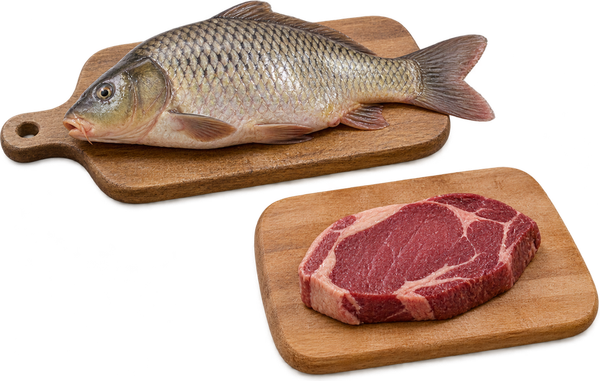
Of water creatures, anything with both fins and scales (סְנַפִּיר וְקַשְׂקֶשֶׂת, snapir ve-kaskeset) is permitted. Fish require neither shechitah nor salting, and the Torah does not forbid the blood of fish. Fish are pareve; according to halakhah, however, they are not eaten together with meat.6,7,8
All seafood is therefore forbidden (shrimp, lobster, crab, mussels, oysters, octopus), as are eel, catfish and sharks. In the common interpretation, the scales must be removable from the skin without damaging it, which is why some species are disputed. Well-known examples are sturgeon (and hence true caviar) and swordfish: Orthodox practice rejects them, while rulings of the Conservative movement in the US have permitted eating them.
In practice, fish is bought either whole, so that the scales can be recognized, or with certification. With skinless fillets the customer can rely only on a trustworthy seller; for canned fish, sauces and fish products people rely on a hechsher.
Birds and tradition (mesorah)
For birds the Torah gives no signs but lists the forbidden species: among them the eagle, vultures, ravens, the ostrich, owls, the stork, the heron and the bat. Some of the Hebrew names can no longer be identified with present-day species with certainty.9,10
The Mishnah gives the sign of an unclean bird (being a predator) and the marks of a clean bird (among them a crop and a gizzard lining that can be peeled off). Because the names in the Torah are uncertain, halakhah in practice requires a tradition (mesorah, מְסוֹרָה): only birds that a community has long known to be kosher are eaten. Universally accepted are the chicken, turkey, duck, goose, pigeon and quail.11,12
Some species have a tradition only in some communities. The classic case is the turkey, an American bird without an old mesorah, whose consumption nonetheless became universal; for guinea fowl, pheasant or Muscovy duck customs differ, and some communities do not eat them.
Insects and checking vegetables
The Torah forbids “swarming things”, that is insects and small creeping creatures, and counts this among the severe prohibitions. The exception is a few species of locust with jumping legs.13,14
Most communities do not eat locusts, because the reliable tradition about which species are permitted was lost. Some Yemenite Jews and certain North African communities preserved this tradition and eat particular locusts.
The most important practical consequence is checking vegetables, fruit and grain for insects. In Orthodox practice, leafy greens (lettuce, parsley, kale), broccoli, cauliflower, strawberries or legumes are soaked, rinsed and inspected, or bought grown so as to be insect-free. Flour is sifted.15
Halakhah distinguishes insects visible to the naked eye (forbidden) from microscopic organisms, which the prohibition does not cover. The degree of checking varies: some certification agencies have very strict procedures for particular vegetables, while other authorities are satisfied with thorough washing.
Animal products: eggs, milk, honey
The general principle is that what comes from an unclean animal is forbidden. Milk is permitted only from kosher mammals (cow, goat, sheep), eggs only from kosher birds; an ostrich egg is therefore forbidden just like the ostrich. Milk and eggs of permitted animals do not require shechitah.
Eggs are pareve. In many households they are cracked into a bowl before use and checked for a blood spot; according to prevailing practice an egg with blood is discarded. The sources, however, distinguish fertilized and unfertilized eggs, and with today's large-scale farming this is more a matter of custom and caution.
Honey is the well-known exception: the bee is a forbidden insect, but the Talmud permits honey because the bee does not produce it from its own body but only processes nectar. Royal jelly, by contrast, is a matter of dispute.
A rabbinic enactment is chalav Yisrael (חֲלַב יִשְׂרָאֵל): milk milked by a non-Jew without Jewish supervision should not be drunk, lest milk of unclean animals be mixed in. Some Orthodox authorities hold that government inspection of milk in modern countries fulfils this purpose (chalav stam); others insist on supervision.16
Communities and movements
The list of permitted animals is essentially shared by all communities; the differences concern mainly traditions about birds and locusts, the strictness of insect checking and customs regarding certain fish.
Orthodox and Conservative (Masorti) Judaism regard these prohibitions as binding, though the Conservative movement leans toward more lenient rulings in some borderline cases. Reform Judaism treats kashrut as a personal choice; many Jews who otherwise do not keep kashrut nonetheless avoid pork and seafood.
שאלות נפוצות
Are shrimp or calamari kosher?
No. They have neither fins nor scales, so all traditional interpretations forbid them. Products made from them are forbidden too, for example crab sticks made from real crab meat or sauces with oyster extract.
Why is pork forbidden when the pig has split hooves?
Because both signs must apply at once. The pig does not chew the cud, and the Torah therefore names it explicitly as forbidden.
Is turkey kosher?
In prevailing practice yes, if it is properly slaughtered and prepared. The turkey had no old tradition, but eating it became accepted in all the main communities.⁂ לאימות
Do I have to check lettuce for insects?
In Orthodox practice yes: the leaves are soaked, rinsed and inspected, or lettuce grown and certified as insect-free is bought. The exact procedure varies by authority and by type of vegetable.⁂ לאימות
May honey be eaten if bees are not kosher?
Yes. The Talmud explicitly permits honey because it does not come from the bee's body. It is the best-known exception to the rule that products of unclean animals are forbidden.⁂ לאימות
מקורות
מקורות ראשוניים
- 1Leviticus, 11:2–3 text ↗
- 2Deuteronomy, 14:4–6 text ↗
- 3Leviticus, 11:4–7 text ↗
- 4Deuteronomy, 14:7–8 text ↗
- 5Shulchan Arukh, Yoreh De’ah, 79 text ↗
- 6Leviticus, 11:9–12 text ↗
- 7Deuteronomy, 14:9–10 text ↗
- 8Shulchan Arukh, Yoreh De’ah, 83 text ↗
- 9Leviticus, 11:13–19 text ↗
- 10Deuteronomy, 14:11–20 text ↗
- 11Mishnah Chullin, 3:6 text ↗
- 12Babylonian Talmud, Chullin, 63b text ↗
- 13Leviticus, 11:20–23 text ↗
- 14Leviticus, 11:41–44 text ↗
- 15Shulchan Arukh, Yoreh De’ah, 84 text ↗
- 16Mishnah Avodah Zarah, 2:6 text ↗
- 17Leviticus, 11:7 text ↗
- 18Leviticus, 11 text ↗
- 19Deuteronomy, 14:3–21 text ↗
- 20Mishnah Chullin
- 21Shulchan Arukh, Yoreh De’ah
- 22Mishneh Torah, Hilchot ma'achalot asurot